

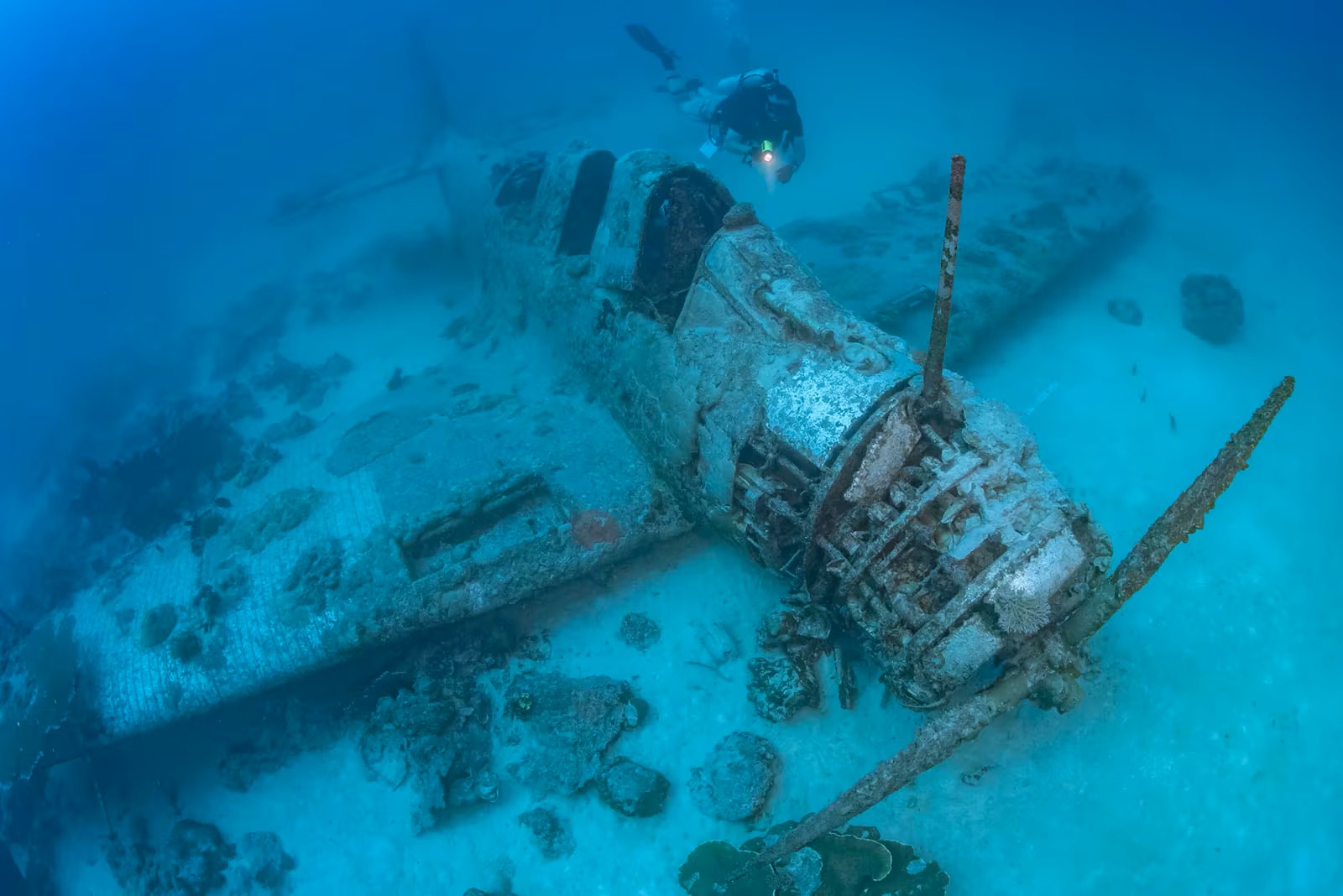
Douglas TBD-1 Devastator BuNo 1515 in its current resting place in the Jaluit lagoon, Marshall Islands. ( Source : Air/Sea Heritage Foundation )
The Naval History and Heritage Command (NHHC) has announced, in an official statement, the launch of an extraordinary project: the recovery of a Douglas TBD-1 Devastator missing since 1942. Of the 129 Devastators built, none has survived to the present day in a museum or private collection. The aircraft, identified as BuNo 1515, is now considered the only example still sufficiently well preserved to make such an operation feasible.
The Devastator holds a unique place in U.S. Navy history: the fleet’s first all-metal torpedo bomber, it marked the beginnings of modern carrier-based aviation and took part in the first American offensives in the Pacific. Yet its career was brief; quickly outclassed by more advanced aircraft, it was nearly erased from collective memory following the catastrophic losses suffered during the early stages of the war.
BuNo 1515 has rested since 1 February 1942 in the lagoon of Jaluit, in the Marshall Islands. On that day, shortly after taking off from the aircraft carrier USS Yorktown during the raid on the Marshall and Gilbert Islands — the first American offensive operation in the Pacific — the aircraft was forced to make an emergency water landing. Its three crew members (Ensign Herbert R. Hein Jr., AOM3C Joseph D. Strahl, and S1C Marshal E. Windham) survived the crash but were captured by the Japanese. They did not regain their freedom until the end of the war in 1945. Their aircraft, however, slowly sank into the lagoon’s waters.
It was not until 1997, following its initial discovery — and especially in 2003 — that the wreck began to attract the attention of specialists. The Air/Sea Heritage Foundation, accompanied by archaeologists and conservators, carried out seven successive expeditions to document the aircraft. Texas A&M University, through its Center for Maritime Archaeology and Conservation, became involved in 2006, notably producing a 3D model using photogrammetry.
Despite more than 80 years underwater, the aircraft remains surprisingly intact — the engine is still in place and the airframe structure is complete, despite its prolonged immersion.

The project, named “The Devastator Project,” now brings together an international partnership: the Air/Sea Heritage Foundation, the Naval History and Heritage Command, Texas A&M’s Center for Maritime Archaeology and Conservation, the Marshall Islands Historic Preservation Office, as well as local authorities from Jaluit Atoll. The recovery of the wreck will follow an extremely strict archaeological and conservation protocol. Once recovered, the aim is to stabilize and preserve the aircraft in its current condition.
An artist’s rendering shows how the Devastator will be displayed in Washington.

An artist’s view showing how the Devastator will be displayed in Washington.
Once stabilized and treated against corrosion, the Devastator will join the collections of the future National Museum of the United States Navy, currently under development in Washington, D.C., and will be the only preserved example in the world.
To learn more, click on the image below:


Recent Comments