

 French aviation artist Romain Hugault is the author of the 2014 Flying Legends airshow poster. The poster shows two Spitfire XIV at (very) low level over a field with poppies, to commemorate the 100th anniversary of the First World War.
Permanent link to this article: https://www.worldwarbirdnews.com/2014/02/18/flying-legends-2014-poster-by-romain-hugault/
Jan 19 2014
Bravo Bravo Aviation celebrates its 5th anniversary!
 Bravo Bravo Aviation, the publisher of World Warbird News, turned five on January 16, 2014. To celebrate, we decided to hand out a few gifts to our fans and followers. From January 16 to February 15, you can try your luck and hope to win one of five A5 prints, to be chosen from our catalog on the website.
Here’s how to do it:
Permanent link to this article: https://www.worldwarbirdnews.com/2014/01/19/bravo-bravo-aviation-celebrates-its-5th-anniversary/
Jan 09 2014
Spitfire Mk XVIII flies again in Duxford

Spitfire SM845 in its former colours. (Photo I wish I was flying (CC BY-ND 2.0))
Spitfire Mk XVIIIe SM845 flew for the first time since 2010 on December 17 in Duxford, with John Romain at the controls. The aircraft now carries colours of a No 28 Squadron RAF Spitfire based in Hong Kong in 1950.
The aircraft was rebuilt after the 2010 crash in Norway that cost pilot Bertil Gerhardt his life.
Sources:
Permanent link to this article: https://www.worldwarbirdnews.com/2014/01/09/spitfire-mk-xviii-flies-again-in-duxford/
Jan 05 2014
January 2014 Airshow now available
 The January 2014 issue of Airshow, the monthly newsletter of the CAF French Wing, is available. For non-members, a public edition is also available and can be downloaded here:
Download the January 2014 issue of Airshow (Public Edition)
You can subscribe to Airshow for free on the CAF French Wing’s website.
Permanent link to this article: https://www.worldwarbirdnews.com/2014/01/05/january-2014-airshow-now-available/
Jan 05 2014
Video: Bloch MB-152 digital recreation project
Following yesterday’s article on the MB-152 project, here is a video giving an overview of the project. Unfortunately for many readers, it’s in French but contains interesting wartime footage and images of the project.
Permanent link to this article: https://www.worldwarbirdnews.com/2014/01/05/video-bloch-mb-152-digital-recreation-project/
Jan 04 2014
Dassault digitally recreates the MB-152
 From the 17th to the 19th of December 2013 at the Dassault center in Saint-Cloud near Paris, an exposition named “MB-152, le pionnier réinventé” [MB-152, the reinvented pioneer] lifted the veil on a remarkable project initiated in 2010 by the association Dassault Passion, with the support of Dassault Aviation. The goal of this project is the “retroconception” in digital form of the MB-152, the first fighter designed by Marcel Dassault and widely used during the Battle of France.
None of the 550 MB-152 fighters built from 1938 to 1940 have survived to this day, and the original plans have disappeared as well. All that is left of the aircraft are photographs, technical documents and a few parts in fairly poor shape. Based on these few elements, a team of Dassault employees decided to retro-design the aircraft. Continue reading
Permanent link to this article: https://www.worldwarbirdnews.com/2014/01/04/dassault-digitally-recreates-the-mb-152/
Dec 31 2013
Unique Lockheed Vega flies again
On December 17th, a unique 1933 Lockheed Vega belonging to John Magoffin flew again. It is is one of nineVegas built by the Detroit Aircraft Corporation as part of the DL-1 series (for “Detroit Lockheed”). The Detroit-built Vega had aluminum fuselages, while the original Vega from Lockheed in California was plywood skinned.
Sources:
Permanent link to this article: https://www.worldwarbirdnews.com/2013/12/31/unique-lockheed-vega-flies-again/
Dec 14 2013
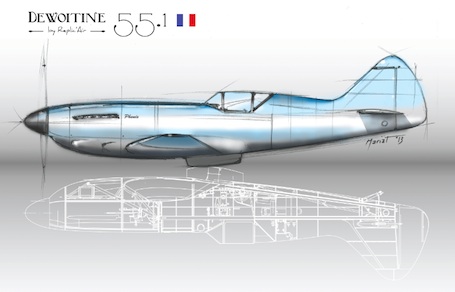
Réplic’Air to build and fly Dewoitine D.551
© Replic’Air
The French association Réplic’Air recently built a Morane-Saulnier Type G replica which flew across the Mediterranean to commemorate Roland Garros’ first flight across that sea in 1913. The association has just announced that its next project will be far more ambitious.
The goal is to build a Dewoitine D.551, and have it fly by June 2017 at the latest. The aircraft, a derivative of the famous Dewoitine D.520 fighter, never flew as France was defeated before it could be produced.
According to Réplic’Air’s Jérémy Caussade, the project is not in the least unrealistic: “There will be a lot of work as far as the engine is concerned, but the aircraft was of a fairly simple construction. It had been designed to be mass-produced. In addition, there is a great deal of documentation concerning it in the Haute-Garonne department archives, which will be of a great help.”
The great challenge for Réplic’Air will be to find a Hispano-Suiza 12Y51 engine, as current plans do not allow for a modern engine to be used. Continue reading
Permanent link to this article: https://www.worldwarbirdnews.com/2013/12/14/replicair-to-build-and-fly-dewoitine-d-551/
Dec 12 2013
Stephen Grey’s P-40B donated to Collings Foundation

Photo Tony Hisgett (CC BY 2.0)
As can be read in its latest newsletter, the Collings Foundation has received an extraordinary donation: the Curtiss P-40B Tomahawk s/n 41-13297 of Stephen Grey’s Fighter Collection It is the oldest flying P-40 and is also the last survivor of the Pearl Harbor attack.
The aircraft is currently being shipped to the US where it will be assembled and flown by the Collings Foundation.
Permanent link to this article: https://www.worldwarbirdnews.com/2013/12/12/stephen-greys-p-40b-donated-to-collings-foundation/
Dec 09 2013
Italian Air Force recovers Reggiane Re.2000 submerged since 1943
The Italian Air Force has recovered a Reggiane Re.2000 that was submerged since 1943, when it crashed in the sea near La Spezia in 1943 during a training mission. The recovery was done graciously by Micoperi, the company responsible for putting back afloat the cruise ship Costa Concordia. The aircraft is currently in a desalination tank and will later be restored and exposed by the Italian AF.
Permanent link to this article: https://www.worldwarbirdnews.com/2013/12/09/italian-air-force-recovers-reggiane-re-2000-submerged-since-1943/
Dec 04 2013
Shell develops lead-free Avgas
 The Shell petrol company announced yesterday that it has developed a 100-octane lead-free aviation fuel destined to replace the 100LL fuel commonly used for piston-engined aircraft. This new fuel, designated D-910, will be sold worldwide at a price comparable to that of the 100LL fuel. The new fuel is to be submitted to the FAA for testing and certification and should be available in two or three years.
Sources:
Permanent link to this article: https://www.worldwarbirdnews.com/2013/12/04/shell-develops-lead-free-avgas/
Dec 03 2013
Claridon Group to back Spitfire search in Burma

A Spitfire Mk XIV at Duxford (Photo Brian Proctor (CC BY-NC-SA 2.0)).
Press release: Global Logistics company Claridon Group Ltd have stepped in to save David Cundall’s project to locate buried Spitfires in Burma. After 16 years of dedicating his life to the project as well as his life savings, David is heading back to Burma to resume excavating and finding the Spitfires.
Due to a lack of sponsorship earlier this year the project looked doomed. After hearing about David’s situation, Claridon, stepped in to provide the funding to allow the project to continue. Claridon who’s HQ are located in Stanford-Le-Hope, Essex also have an office in Burma and are the first privately owned British company to set up there. Continue reading
Permanent link to this article: https://www.worldwarbirdnews.com/2013/12/03/claridon-group-to-back-spitfire-search-in-burma/
Dec 01 2013
Bravo Bravo Aviation Christmas Special: buy 2 large prints, get one free!
This year again, we are offering our special 1+1=3 deal for Christmas. Buy two large prints from Bravo Bravo Aviation and get a third one for free!
Bravo Bravo Aviation’s prints make great presents for pilots, veterans, active service members and aviation enthusiasts. Visit our website to discover our wide selection of prints.
 Merry Christmas to all !
Permanent link to this article: https://www.worldwarbirdnews.com/2013/12/01/bravo-bravo-aviation-christmas-special-buy-2-large-prints-get-one-free/
Nov 30 2013
Handley-Page O/400 wings found in garage

A Handley Page O/400 of the Royal Naval Air Service, 1918. Wings and interplane struts are finished with an experimental mottled camouflage scheme. (Photo Library and Archives Canada)
The wings of a Handley-Page O/400 heavy bomber were recently recovered by the RAF Museum Cosford, who was alerted by email that the wings of a World War Two bomber were being used to support the roof of a garage that was scheduled for demolition.
Personnel from the museum quickly realised that the wings were built with techniques dating from World War One and established that they belonged to a Handley-Page O/400 heavy bomber. They have been recovered and added to the museum’s collections.
Read more about this on Warbirds News.
Permanent link to this article: https://www.worldwarbirdnews.com/2013/11/30/handley-page-o400-wings-found-in-garage/
Nov 17 2013
Cessna donates L-19 “Bird Dog” to Armed Forces Foundation

A U.S. Army Cessna O-1A Bird Dog (s/n 51-12711) in flight. (Photo US Army)
Cessna has donated a1953 Cessna L-19 Bird Dog to the Armed Forces Foundation. The aircraft, which has been fully restored, will be auctionned in January 2014. The funds from the sale will be used to help veterans and their families.
Source: AeroBuzz
Permanent link to this article: https://www.worldwarbirdnews.com/2013/11/17/cessna-donates-l-19-bird-dog-to-armed-forces-foundation/
Latest Prints

Advertising

Recent Comments